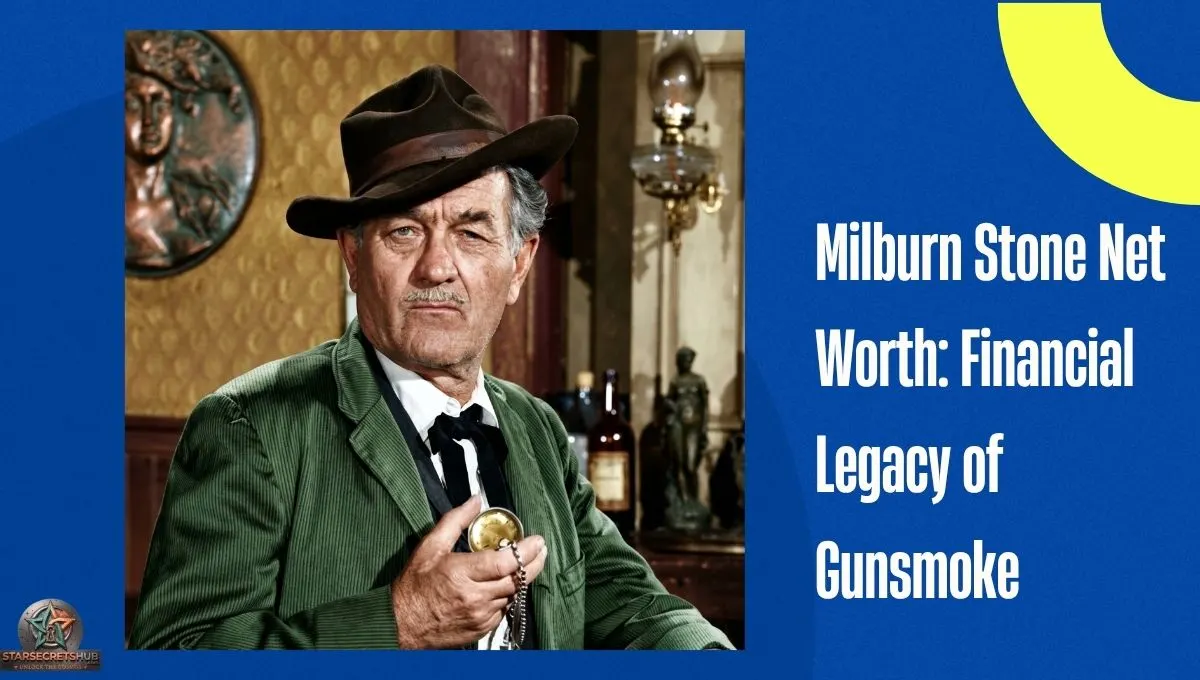
Milburn Stone’s exact net worth at the time of his death has never been publicly confirmed. No reliable probate inventory, CBS contract, tax filing, or contemporaneous financial disclosure establishes a defensible dollar amount. Therefore, online estimates should not be presented as verified fact.
What can be documented is the long career behind his financial success. Stone worked in stage productions, vaudeville, films, television, and live appearances before becoming famous as Dr. Galen “Doc” Adams on the CBS Western drama Gunsmoke.
He remained associated with the series throughout its 20-season television run and won a Primetime Emmy Award in 1968.
Bio
| Detail | Verified information |
| Full name | Hugh Milburn Stone, commonly credited professionally as Milburn Stone |
| Date of birth | July 5, 1904 |
| Birthplace | Burrton, Kansas, United States |
| Profession | Film, stage and television actor |
| Best known for | Dr. Galen “Doc” Adams in Gunsmoke |
| Television run | All 20 seasons of Gunsmoke, 1955–1975 |
| Major award | 1968 Primetime Emmy Award |
| Spouses | Ellen Morrison; later Jane Garrison, whom he married twice |
| Child | Daughter Shirley Stone Gleason |
| Date of death | June 12, 1980 |
| Age at death | 75 |
| Place of death | La Jolla, California |
| Cause of death | Heart attack |
| Burial place | El Camino Memorial Park in San Diego, California |
| Confirmed net worth | Not publicly disclosed |
Who Was Milburn Stone?
Milburn Stone was an American character actor whose career developed over several decades rather than through one sudden Hollywood breakthrough. Before becoming television’s famous Doc Adams, he performed with traveling theatrical companies and appeared in numerous supporting, character and occasionally leading film roles.
The Kansas Historical Society reports that he progressed from traveling theater and stage work to appearances in more than 150 movies. The American Film Institute’s catalog records at least 138 feature-film cast entries, although its total differs because film databases do not always count uncredited work, shorts, serial chapters and television credits in the same way.
His lasting fame came from Gunsmoke. Stone played the experienced, sharp-tongued but compassionate physician Dr. Galen Adams opposite James Arness as Marshal Matt Dillon. His performance made Doc more than a supporting character: he became a source of medical knowledge, moral judgment, humor and emotional stability within Dodge City.
Early Life and Education
Stone was born to Herbert and Laura Belfield Stone in Burrton, a small community in central Kansas. He spent part of his childhood in Burrton and nearby Larned. He was also the nephew of Fred Stone, a prominent Broadway comedian and stage performer, giving him an early family connection to professional entertainment.
The strongest historical account states that he entered traveling theater after completing high school. A contemporary Los Angeles Times obituary added that he turned down a congressional appointment to the United States Naval Academy and chose to join a touring theatrical company instead.
Some secondary biographies claim that he attended Kansas State University. However, the Kansas Historical Society, Television Academy and contemporary obituary material reviewed for this article do not confirm a completed university program or degree. The college-attendance claim should consequently be treated as unverified rather than presented as an established biography.
Stone’s most important early education was practical. Touring companies exposed him to acting, singing, timing and live audience reactions. He later worked in vaudeville and onstage before moving toward motion-picture work in Hollywood.
Acting Journey and Career Highlights
Stone’s screen career began during the 1930s. AFI records roles in films such as His Night Out, Murder with Pictures, The Man I Marry, Atlantic Flight and Federal Bullets. He frequently played reporters, detectives, sailors, officers, criminals and other supporting characters.
He also appeared as Skeeter Milligan in the aviation adventures Mystery Plane, Sky Patrol and Danger Flight. In later years, his filmography included Young Mr. Lincoln, Gung Ho!, Phantom Lady, Captive Wild Woman, The Frozen Ghost, The Judge, Roadblock, Pickup on South Street, Black Tuesday and The Long Gray Line.
This extensive film career did not necessarily make him one of Hollywood’s highest-paid stars. Character actors often moved between small credited parts, uncredited appearances, serials and supporting roles. Nevertheless, consistent employment gave Stone professional experience and an income base long before his television career reached its peak.
His experience also explains why Doc Adams felt fully developed from the beginning. Stone had already spent approximately two decades portraying authority figures, working men, villains and professionals before CBS cast him as Dodge City’s doctor.
Rise to Fame as “Doc Adams” on Gunsmoke
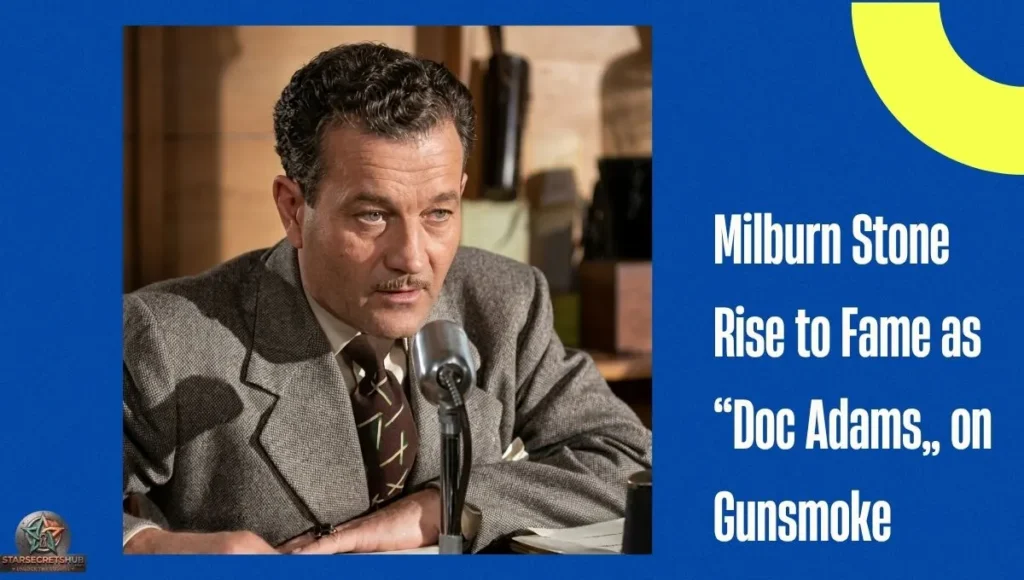
CBS adapted its successful Gunsmoke radio drama for television in 1955. The television version cast James Arness as Matt Dillon, Amanda Blake as Kitty Russell, Dennis Weaver as Chester Goode and Stone as Doc Adams.
The doctor’s full character name was Dr. Galen Adams. Stone gave Doc a blunt, sometimes irritable personality while maintaining the compassion expected of the town’s physician. His exchanges with Matt, Kitty, Chester and later Festus Haggen helped balance the series’ violence and moral tension.
Gunsmoke ran for 20 seasons and produced 635 television episodes. Stone remained part of the program across its entire run, although illness temporarily limited his appearances in 1971. After suffering a heart attack and undergoing surgery, he was briefly replaced in the story by Pat Hingle as Dr. John Chapman. Stone subsequently returned and continued until the series ended in 1975.
There is a minor disagreement over his exact episode total. IMDb lists 605 episodes, while the official website of the Milburn Stone Theatre lists 604. Because the underlying counting method is not explained, the most reliable description is that he appeared in approximately 604–605 episodes across all 20 seasons.
That level of continuity was financially significant. Unlike a performer moving between short-term jobs, Stone received recurring employment from one of American television’s most successful Western dramas for two decades.
Awards, Achievements, and Career Impact
Stone won the 1968 Primetime Emmy Award for Outstanding Performance by an Actor in a Supporting Role in a Drama. The Television Academy records one nomination and one win for his work on Gunsmoke.
He also received a 1972 Golden Globe nomination for supporting actor in a television series or television movie.
His additional honors included:
- A star on the Hollywood Walk of Fame for his contribution to entertainment.
- Recognition connected with the Western Heritage Awards for acclaimed Gunsmoke episodes, including “Death Watch” and “Pike.”
- Posthumous induction into the National Cowboy & Western Heritage Museum’s Hall of Great Western Performers. The museum recognizes performers who made important contributions to Western film, television and stage entertainment.
- Honorary membership in the Kansas Medical Society and an honorary doctorate from St. Mary of the Plains College in Dodge City.
These achievements demonstrate that his professional value was not based solely on the length of his contract. Doc Adams became one of classic television’s most recognizable supporting characters.
Net Worth and Earnings Overview
What was Milburn Stone’s net worth at death?
The honest answer is that his net worth is unknown. Authoritative biographical sources document his career, awards and death but do not publish an estate valuation, investment portfolio, total assets or lifetime earnings.
| Financial question | Evidence-based answer |
| Exact net worth at death | Not publicly confirmed |
| Verified estate value | No public inventory located |
| Verified salary per episode | Not publicly documented |
| Primary income source | Professional acting, especially Gunsmoke |
| Other established earnings | Film roles, stage work, vaudeville and personal appearances |
| Verified investments | No dependable public documentation found |
| Residual or royalty total | Exact terms and payments remain unconfirmed |
| Financial condition at retirement | No audited or primary financial disclosure available |
Numerical estimates published by celebrity-wealth websites generally do not identify probate documents, tax records, payroll statements or authenticated contracts. Repeating those figures would create false precision.
Comparisons with James Arness’ net worth, Amanda Blake’s net worth, Dennis Weaver’s net worth or Ken Curtis’ net worth present the same problem. Unless each figure comes from equivalent estate or financial documentation, a “Gunsmoke cast net worth” ranking is not a reliable comparison.
The defensible conclusion is that Stone likely achieved greater financial stability during his television years than during his earlier character-actor career. However, financial stability is not the same as a verified fortune.
Milburn Stone’s Salary Per Episode on Gunsmoke
No trustworthy public source reviewed for this article provides an authenticated salary-per-episode figure.
Many entertainment articles publish supposed early-season, peak-season or annual salary amounts. These claims rarely include a copy of his CBS contract, a payroll record, a contemporaneous trade report or an interview in which Stone stated the amount himself.
His compensation probably changed during the show’s 20 seasons. That would be normal for a long-running program because contracts could be renegotiated as ratings, episode lengths, production schedules and a performer’s importance changed. Nevertheless, assigning a specific number without documentation would be speculation.
A frequently repeated claim says that Stone sold certain Gunsmoke residual rights to CBS for $100,000 in 1961. The statement appears in IMDb trivia and several websites that seem to repeat the same information, but no publicly accessible contract or primary CBS document was found to authenticate the transaction. It should be described as a reported claim, not a verified payment.
Therefore:
Stone’s total Gunsmoke earnings and salary per episode remain undisclosed. Any exact figure should be treated cautiously unless supported by an original contract or contemporary financial record.
How Milburn Stone Built His Wealth
Stone built his financial position through longevity rather than one publicly documented blockbuster payday.
Decades of film employment
His film work extended from the 1930s into the 1950s. Although many roles were small, the large number of appearances created a continuous acting income and helped him build the reputation that led to television casting.
Twenty seasons of television work
A regular role lasting from 1955 to 1975 provided unusual employment security for a supporting actor. Even without knowing his salary, a two-decade CBS contract history was almost certainly the central source of his career earnings.
Increasing professional value
As Doc became an audience favorite, Stone’s importance to the ensemble increased. His Emmy win and later Golden Globe nomination strengthened his industry standing and likely supported his position in contract discussions, although the results of any negotiations are not publicly available.
Live appearances
At the height of the Western’s popularity, he appeared at rodeos, fairs and other public events connected with his television persona. The Los Angeles Times reported that he toured the rodeo and state-fair circuit, initially alongside other cast members. Such events could have generated appearance fees in addition to promoting the series.
Possible residual income
Television residuals may have contributed to his earnings, but the duration and value of his rights cannot be calculated from available evidence. Claims about permanent royalties, syndication income or a residual-rights sale remain insufficiently documented.
Don’t Miss: Serena Neel Biography (2026) – Age, Husband, Net Worth & Lifestyle
Major Income Sources Beyond Acting
Stone’s documented career was overwhelmingly entertainment-based. His non-screen income likely came from related professional activities rather than a publicly known business empire.
These activities included:
- Traveling theater and repertory work: His early career involved live theatrical companies before he established himself in Hollywood.
- Vaudeville and musical performance: He developed experience as a singer and live entertainer, not only as a dramatic actor.
- Rodeo and state-fair appearances: His association with a major Western series created demand for personal appearances.
- Public events and promotional work: Long-running television performers regularly participated in press, promotional and fan events, although Stone’s individual fees are not public.
- Charitable and civic activities: The Kansas Historical Society records his involvement in civic and charitable causes, although these were contributions to his legacy rather than proven sources of income.
There is no dependable evidence of a major investment portfolio, production-company ownership, endorsement empire or extensive commercial property business. Articles claiming substantial passive income from real estate or investments generally provide no records.
Reports that he owned boats are supported by accounts of his personal interests, but a personal boat is an asset or expense—not evidence of an income-producing business.
Personal Life, Family, and Relationships
Stone married Ellen Morrison in the 1920s. Their marriage continued until her death in 1937, and they had a daughter, Shirley Stone Gleason.
He later married Jane Garrison. Their relationship included an early marriage and divorce followed by remarriage in the 1940s. They remained together until his death in 1980. Jane died in 2002. Her obituary identified Shirley, four grandchildren and several great-grandchildren among the surviving family.
Stone maintained close ties with Kansas despite living on the West Coast. The Kansas Historical Society notes that he supported civic and charitable causes in several Kansas communities and named one of his boats the Jayhawk.
He suffered a serious heart attack in 1971 but recovered sufficiently to return to Gunsmoke. After CBS ended the series in 1975, he retired from acting. Five years later, on June 12, 1980, he died following another heart attack at Scripps Memorial Hospital in California.
Must Read : Stray Kids Net Worth 2026 (Updated Wealth, Members Earnings & Income Breakdown)
Estate, Assets, and Financial Legacy After His Death
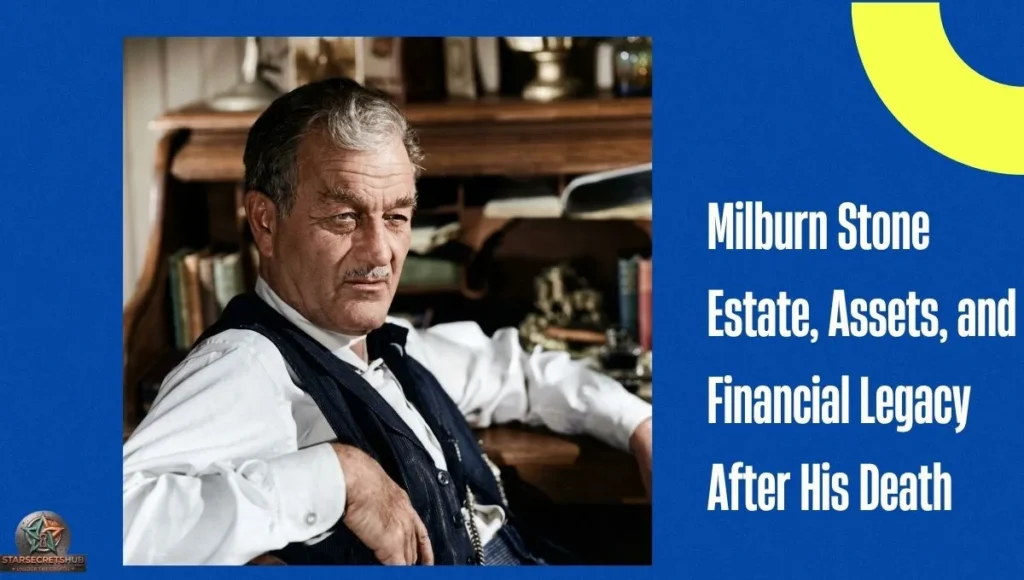
No publicly accessible probate summary establishes Milburn Stone’s estate value. Reliable sources do not provide a complete list of his real estate, cash, securities, personal possessions, debts or testamentary distributions.
His burial location is better documented. Jane Garrison Stone’s obituary states that she was interred beside her husband at El Camino Memorial Park in San Diego. The obituary also confirms the family structure but does not reveal the monetary value of either estate.
His most visible financial and philanthropic legacy is associated with the performing arts. The Milburn Stone Theatre at Cecil College in North East, Maryland, is named in his honor. The theatre’s history says that his charitable legacy helped establish the venue and that his wife and daughter were long-time benefactors.
That contribution is more meaningful than an unsupported celebrity-net-worth figure. His family’s support helped attach his name to an active cultural institution that presents theater, music, dance, films and educational programs.
However, the theatre’s existence does not reveal the total size of his estate. A charitable contribution or family donation cannot be used to reverse-engineer a credible net worth.
Legacy and Influence in Hollywood
Milburn Stone’s Hollywood legacy rests on the transformation of a supporting role into an essential television character.
Doc Adams was not the fastest gun in Dodge City or the show’s central romantic figure. His importance came from reliability. He treated injuries, challenged poor decisions and provided a humane counterweight to the violence surrounding Matt Dillon.
Stone’s performance also helped establish the television doctor as more than a clinical authority. Doc could be argumentative, humorous, exhausted, loyal and emotionally affected by patients. Those qualities made him believable and allowed viewers to form a long-term attachment to the character.
His Emmy, Golden Globe nomination, Walk of Fame recognition and Western entertainment honors demonstrate lasting industry respect. His name continues through reruns, television archives, Western-history institutions and the Maryland theatre created in his honor.
Conclusion
Milburn Stone’s net worth cannot be stated responsibly as a confirmed dollar amount. Neither his exact Gunsmoke salary nor his final estate value appears in reliable public documentation.
His verified financial story is still substantial. He built a durable career through stage work, more than a hundred feature-film appearances, two decades of television employment and live promotional appearances. He then left a cultural legacy that extended beyond personal wealth through the Milburn Stone Theatre and continuing recognition of his work as Doc Adams.
For readers asking how much he was worth, the most accurate conclusion is simple: the number is unknown, but his professional and cultural value to American television is thoroughly documented.
FAQs
What was Milburn Stone’s net worth?
His exact net worth was never publicly confirmed. Published estimates lack supporting probate, contract or financial records.
How much did he earn on Gunsmoke?
His total Gunsmoke earnings are unknown because CBS payroll records and authenticated contract figures have not been made publicly available.
Who played Doc Adams?
Stone played Dr. Galen “Doc” Adams throughout the 20-season television run of CBS’s Gunsmoke.
What was his salary per episode?
No reliable primary source provides a verified per-episode salary, so specific amounts published online should be treated as speculation.
How many Gunsmoke episodes did he appear in?
Sources disagree slightly: IMDb lists 605 episodes, while the Milburn Stone Theatre lists 604. He appeared across all 20 seasons.
Did he receive royalties from Gunsmoke reruns?
Residual arrangements have been reported, but the exact contractual terms, payments and duration are not confirmed by an accessible primary document.
Did he win an Emmy Award?
Yes. He won the 1968 Primetime Emmy for Outstanding Performance by an Actor in a Supporting Role in a Drama.
Who was Milburn Stone’s wife?
He was married first to Ellen Morrison and later to Jane Garrison, whom he remarried after an earlier divorce.
Did he have children?
Yes. He had one known daughter, Shirley Stone Gleason, from his marriage to Ellen Morrison.
When did he die?
He died from a heart attack on June 12, 1980, in La Jolla, California, at age 75.
Where is he buried?
He is interred at El Camino Memorial Park in the San Diego area, where Jane Garrison Stone was later buried beside him.
Is the Milburn Stone Theatre named after him?
Yes. The performing-arts venue at Cecil College in Maryland bears his name, and its history recognizes his family’s support.
What movies did he appear in?
Notable credits include Young Mr. Lincoln, Gung Ho!, Phantom Lady, The Judge, Pickup on South Street, Black Tuesday and The Long Gray Line.

Khurram Ali is a dedicated content writer at StarSecretsHub.com, specializing in celebrity biographies, net worth analysis, and lifestyle insights. He creates well-researched, engaging, and easy-to-read content that explores the lives, success stories, and hidden facts of global celebrities. With a strong focus on accuracy and SEO-friendly writing, Khurram aims to deliver valuable and entertaining content for readers interested in the world of fame and fortune.